

PEMF Therapy: Science, Benefits & At-Home Recovery
At a Glance
- PEMF reduces joint pain by 36% versus 10% for standard care — with medication use down 55% [1]
- Works by delivering pulsed electromagnetic pulses that generate microcurrents at the cellular level — not heat, not static magnets
- Four parameters drive outcomes: frequency, intensity, session duration, and application site — changing any one shifts results
- Evidence is strongest for musculoskeletal pain and joint function — cognitive and immune claims are still early-stage
- PEMF works best as one layer of a broader recovery system, not as a standalone fix
- Consistent daily use outperforms sporadic high-intensity sessions every time
PEMF therapy has moved from hospital research labs into home recovery rooms, and the conversation around it is louder than ever. Athletes, physical therapists, and everyday wellness seekers are adding it to their routines — yet most people still aren't sure what it actually does or whether it lives up to the hype.
The skepticism is fair. Wellness technology has a history of overpromising. But PEMF has a growing body of clinical research behind it, and understanding the science separates the signal from the noise. This guide covers what PEMF therapy is, what the evidence actually supports, and how to use it effectively at home.
What Is PEMF Therapy? A Science-Backed Explanation
PEMF stands for pulsed electromagnetic field therapy. It has been in clinical use since the 1970s, originally used for bone fracture healing. Since then, its applications have expanded into sports medicine, rehabilitation, and preventive wellness.
At its core, PEMF therapy works by delivering brief, repetitive pulses of electromagnetic energy to your body's tissues. These pulses don't heat tissue or deliver electric shocks. Instead, they generate microcurrents at the cellular level — a low-level signal that nudges your cells back toward their optimal operating state. The effects are subtle but cumulative.
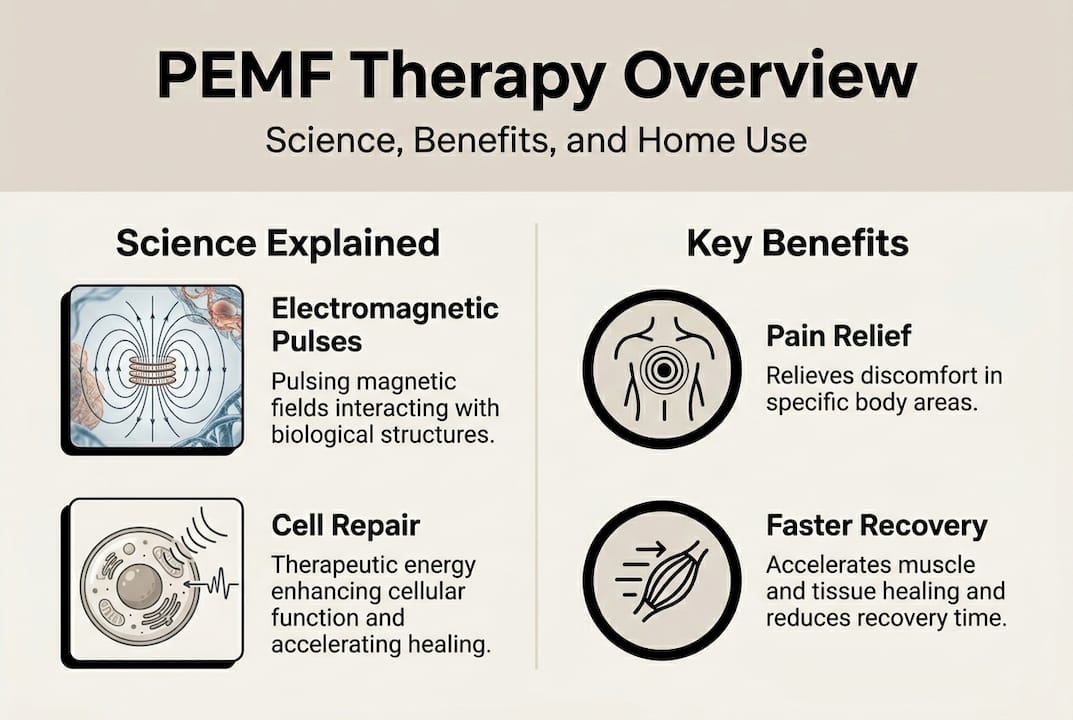
- Cellular repair stimulation: Supports the body's natural regeneration processes at a mitochondrial level, may influence cellular energy metabolism and repair processes.
- Pain modulation: Influences nerve signal transmission to reduce perceived pain without pharmaceutical intervention.
- Inflammation reduction: May help modulate inflammatory signaling pathways, reducing the underlying driver of chronic discomfort.
- Circulation improvement: Promotes vasodilation and microcirculation in treated areas, supporting nutrient delivery and waste clearance.
- Faster recovery: Reduces delayed onset muscle soreness and supports tissue healing between training sessions.
One common misconception is that PEMF is just magnet therapy. It isn't. Static magnets produce a fixed field with no pulse, no frequency variation, and no cellular induction effect. PEMF is dynamic — which is precisely what makes it biologically active. As the PEMF technology guide explains, it works by inducing microcurrents in tissues via Faraday's law to stimulate cellular repair, improve circulation, reduce inflammation, and enhance recovery [2].
PEMF therapy is not fringe science. It has been studied in peer-reviewed clinical trials across orthopedics, neurology, and sports medicine, with measurable outcomes in pain and tissue recovery.
You can explore the full range of options in the PEMF therapy collection, or start with a full-body option like the OMI PEMF Full Body Mat for whole-system sessions.
Health Benefits of PEMF: Evidence and User Experiences
The strongest clinical data for PEMF centers on musculoskeletal pain and joint function. The numbers are not marginal — they are clinically significant.

| Outcome | PEMF Therapy | Standard Care |
|---|---|---|
| Pain reduction | 36% | 10% |
| Medication use reduction | 55% | Minimal |
| Joint function improvement | Significant | Moderate |
| Inflammation markers | Reduced | Variable |
Beyond the clinical data, consistent real-world use produces:
- Reduced morning stiffness and joint discomfort
- Faster bounce-back after intense training sessions
- Some users report better relaxation and recovery
- Decreased reliance on NSAIDs and over-the-counter pain relief
Where the research is still evolving: cognitive benefits, systemic immune effects, and long-term applications are areas with early but not yet conclusive data. Responsible use means focusing on what is proven and treating speculative claims with appropriate skepticism.
For targeted recovery, the OMI PEMF Mini Mat is a practical choice for localized areas like the lower back or knees. For joint-specific use, the OMI PEMF Ring wraps directly around a limb for concentrated field delivery. You can also read more about recovery with red light and PEMF to see how stacking modalities accelerates results.
What Most People Miss: Nuances in PEMF Effectiveness
The data is promising — but results vary. Here's why, and what most guides don't cover.
Not all PEMF devices are equal, and not all protocols work the same way. The four parameters that determine outcomes are frequency, intensity, session duration, and application site. Changing any one of these can shift results significantly. Research confirms that low-intensity devices may underperform for certain regenerative applications compared to higher-intensity clinical devices [3].
Positive RCTs and meta-analyses support PEMF for pain and osteoarthritis, but results for soft tissue and functional outcomes remain mixed due to protocol heterogeneity and study design variability [4]. PEMF works — but it is not a universal fix, and the "one device fits all" approach is a red flag.
| Parameter | Why It Matters | What to Look For |
|---|---|---|
| Frequency (Hz) | Affects tissue depth and cellular response | Match to condition — e.g. 10 Hz for pain, higher for bone |
| Intensity (Gauss/Tesla) | Determines field strength in tissue | Clinical use often requires higher intensity |
| Session duration | Cumulative exposure drives results | 20 to 40 minutes per session is typical |
| Application site | Proximity matters for field delivery | Direct contact or close placement preferred |
Before choosing a PEMF device, work through these questions:
- What is my primary goal — pain relief, recovery, performance, or general wellness?
- Does the device offer adjustable frequency and intensity settings?
- Is the device backed by peer-reviewed research or only testimonials?
- What is the treatment area size, and does the device match it?
- Is there a warranty, return policy, and customer support available?
For targeted, wearable use, the OMI PEMF Medallion is a compact option you can wear throughout the day. For facial recovery and skin support, the PEMF face mask delivers localized treatment with precision.
How to Use PEMF Therapy at Home
Setting up a home PEMF routine doesn't require a clinical background. It requires consistency and a basic understanding of how to apply the tool correctly.
Step 1 — Choose Your Device
Match the device to your primary recovery goal and treatment area. Full mat for whole-body. Ring or mini mat for targeted joints. Medallion for daily wearable use.
Step 2 — Set Parameters
Set frequency and intensity according to the manufacturer's guidelines for your condition. Do not use generic fixed settings — match to goal.
Step 3 — Position and Session Length
Place device directly on or near the target area. Begin with 15 to 20 minute sessions, once or twice daily. Build from there.
Step 4 — Track and Adjust
Track baseline pain, sleep quality, and soreness before starting. Reassess every two weeks and adjust session length or frequency as needed.
PEMF pairs powerfully with other recovery modalities:
- Infrared sauna: Use PEMF before a sauna session to prime circulation, then let heat amplify the vasodilation effect.
- Cold plunge: Apply PEMF after cold exposure to support tissue recovery as circulation rebounds.
- Compression therapy: Layer PEMF with compression for post-training muscle recovery.
- Red light therapy: Combine for synergistic cellular energy and repair effects — the two modalities target overlapping pathways.
For a complete home setup, the full-body PEMF set covers the mat, ring, and pulse pad for full-system coverage. You can also explore how contrast therapy integrates with PEMF for a layered protocol.
Common pitfalls to avoid:
- Expecting results after one or two sessions — PEMF is cumulative, not instant
- Using the same generic settings for every condition — adjust parameters to your goal
- Skipping sessions when you feel fine — consistency during low-symptom periods maintains gains
- Placing the device too far from the target tissue — proximity directly affects field delivery
What Actually Matters When Using PEMF
Most PEMF guides obsess over device specs — frequency ranges, Gauss ratings, waveform shapes. And while those details matter, they're not what separates people who get results from those who don't.
What actually drives outcomes is consistency and realistic expectations. Users with mid-range devices regularly outperform those with premium hardware simply because they show up every day. Short, regular sessions build the cumulative cellular effect that PEMF depends on. Sporadic high-intensity sessions don't replicate that.
The other thing conventional wisdom gets wrong is treating PEMF as a standalone solution. It isn't. It's infrastructure for a broader recovery system. When you layer it with tools like red light and compression, the combined effect is greater than any single modality alone. Explore the full range of nervous system wellness tools that complement PEMF for stress, sleep, and performance.
PEMF won't undo poor sleep, chronic stress, or inadequate nutrition. But for someone already doing the fundamentals well, it's a meaningful upgrade.
Realistic expectations aren't a limitation. They're what make the tool actually work for you.
FAQ: PEMF Therapy
Is PEMF therapy safe to use at home?
When used as directed, PEMF therapy is generally low risk when used as directed by healthy adults. Anyone with implanted electronic devices, pacemakers, or active medical conditions should consult their healthcare provider before starting.
How quickly will I see results from PEMF therapy?
Many users notice reduced pain or improved recovery within 2 to 4 weeks of consistent use, though individual responses vary based on condition severity and protocol. Clinical trials confirm significant pain reduction with regular PEMF application — but it is cumulative, not instant.
Can PEMF therapy replace other recovery methods?
PEMF works best as part of a holistic recovery routine and should complement — not replace — physical therapy, exercise, or medical treatment. Research supports PEMF as an adjunct, not a standalone cure.
Who should avoid PEMF therapy?
People with pacemakers, implanted electrical devices, or who are pregnant should consult a doctor before using any PEMF device, as the electromagnetic fields may interfere with implanted electronics, and safety data for pregnancy are limited.
How do I choose the right PEMF device?
Match the device to your specific goal, treatment area, and required intensity level. Prioritize brands with transparent parameter disclosures — exact frequency and intensity ranges — and clinical backing. Generic devices with fixed settings may not deliver optimal results for your condition.
What is the difference between PEMF and static magnet therapy?
Static magnets produce a fixed field with no pulse, no frequency variation, and no cellular induction effect. PEMF is dynamic — it generates time-varying fields that induce microcurrents in tissue via Faraday's law. That dynamic quality is what makes PEMF biologically active in ways static magnets are not.
How does PEMF pair with other recovery tools?
PEMF pairs well with infrared sauna, cold plunge, red light therapy, and compression. Use PEMF before sauna to prime circulation, or after cold plunge to support tissue recovery as circulation rebounds. Combined protocols produce greater outcomes than any single modality alone.
Build Your Home Recovery System
Browse the full PEMF collection — full-body mats, targeted rings, wearables, and complete sets designed for real-world results.
Sources
- Pain and Therapy, 2025. PEMF vs. standard care: joint pain reduction, medication use, and knee osteoarthritis outcomes. link.springer.com
- MagFine. PEMF pulsed electromagnetic field technology guide: mechanisms and clinical applications. magfine.ca
- PMC, 2025. PEMF efficacy and parameter dependence: intensity, frequency, and application review. pmc.ncbi.nlm.nih.gov
- Frontiers in Sports and Active Living, 2026. RCTs and meta-analyses on PEMF for pain, osteoarthritis, and soft tissue outcomes. frontiersin.org
This article is for informational purposes only and does not constitute medical advice. Always consult a qualified healthcare provider before beginning any new health practice, particularly if you have a pre-existing condition, are pregnant, or are currently taking medication.